
Why Is My Commercial Boiler Making Loud Noises?
Commercial boilers are not subtle pieces of equipment, but they shouldn’t be loud in a way that draws attention. If you’re hearing banging, rumbling, whistling, vibrating or persistent humming from your plant room, then the system is probably telling you something.
In most cases, noise is an early warning sign; boilers rarely go from healthy to failed overnight. The sounds usually start small and get worse as the underlying issue develops.
At North Oxfordshire Heating, we’re fortunate to have experienced engineers on our team, some of whom have been working in the industry for well over 30 years. So they’ve walked into plenty of plant rooms where someone has said, “It’s been making that noise for a while.” More often than not, that delay is what turns a manageable issue into a more expensive one.
Here’s what those noises usually mean.
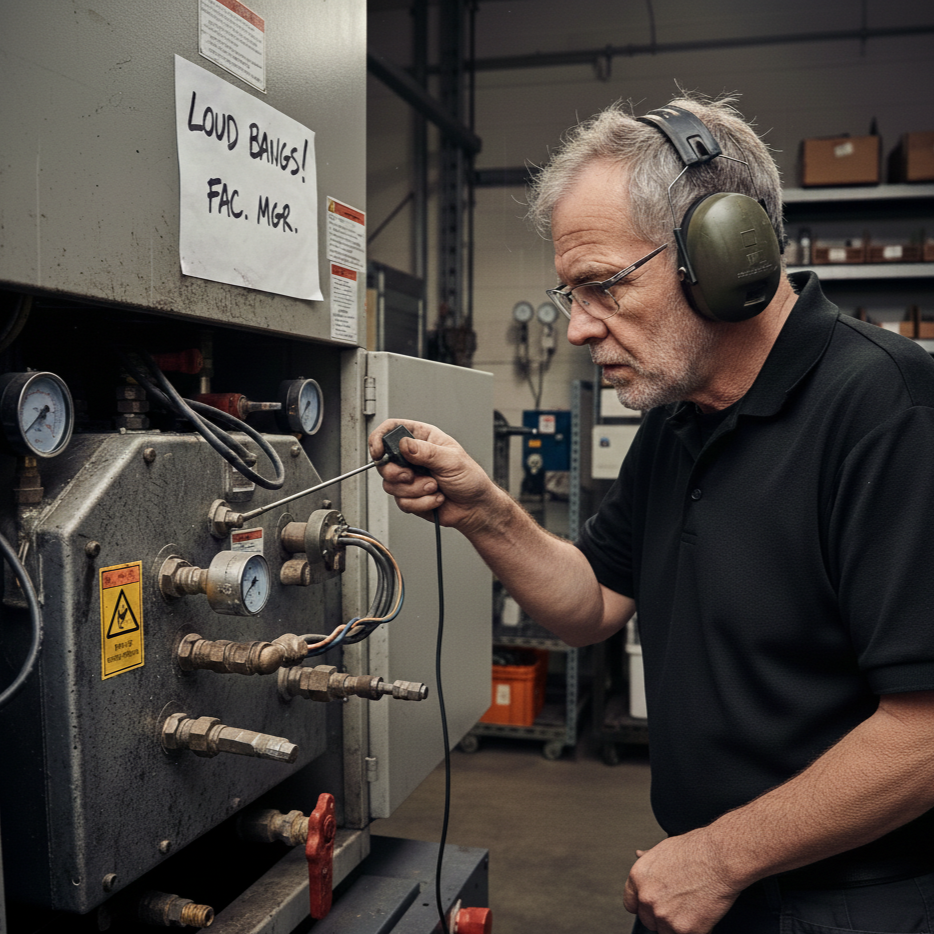
Banging Or Deep Rumbling
If the boiler sounds like it’s boiling a kettle inside, that’s often exactly what’s happening.
This is known as kettling. Over time, limescale and sludge build up inside the heat exchanger, and the build-up restricts water flow. When water can’t move freely, it overheats in certain areas and flashes into steam. The rapid formation and collapse of those steam bubbles causes the rumbling or banging sound.
In commercial systems, this is commonly linked to poor water treatment or systems that haven’t been properly cleaned and maintained over the years. Older pipework sheds debris and extensions get added without full flushing. Gradually, the inside of the system becomes restricted.
Left alone, kettling reduces efficiency and puts serious stress on the heat exchanger. We’ve seen cases where prolonged overheating has warped components or led to premature boiler failure. Caught early, it’s often a cleaning and circulation issue. Left too long, it can become a replacement job.
Whistling Or Gurgling
A whistling sound usually points to restricted flow. Gurgling often means there’s air somewhere it shouldn’t be.
Air can enter through small leaks, during refilling, or because of low system pressure. Once trapped, it disrupts circulation and creates uneven flow. In larger commercial buildings, air pockets can sit in high points of pipework and cause ongoing imbalance.
Whistling can also be caused by partially closed valves, blocked strainers or dirty filters. When water is forced through a narrowed gap at speed, noise is the result.
These aren’t just background sounds. Poor circulation makes the boiler work harder and reduces overall performance. If parts of the building are heating unevenly as well, the two problems are usually connected.
Humming, Vibrating or Droning
If you’re hearing a steady hum or noticeable vibration, the circulation pump is often the place to look.
Commercial pumps run hard. Over time, bearings wear, impellers collect debris, and settings get adjusted incorrectly. When that happens, the pump starts to complain. The noise might be subtle at first, then gradually become more obvious.
When the pump struggles, distribution suffers. Some areas overheat. Others stay cold. The boiler compensates by firing more often, which increases wear across the system.
Engineers with long experience can often tell the difference between a healthy pump and a struggling one just by the tone - it’s something you pick up after decades on site.
Banging Linked To Pressure Issues
Incorrect pressure can also create noise.
If pressure is too low, air enters more easily. If it’s too high, water movement becomes more aggressive, especially as the system heats up and expands. That can lead to knocking sounds in pipework or discharge from the pressure relief valve.
Expansion vessels are frequently involved in these situations. When they lose their internal charge, the system can no longer absorb thermal expansion properly. Pressure fluctuates and the boiler becomes noisy as a result.
Checking pressure readings is simple. Understanding why they’re unstable is where experience matters.
Ticking or Knocking From Pipes
Sometimes the boiler itself isn’t the problem.
As pipework heats up, it expands, and as it cools, it contracts. In long commercial runs, especially in older buildings, that movement can cause ticking or knocking as pipes shift against brackets or surrounding structure.
A bit of expansion noise is normal, but sudden or excessive movement isn’t. If the system temperature or circulation pattern has changed, the pipework will react.
When Should You Be Concerned?
If the noise is loud, persistent or getting worse, it’s worth investigating properly.
Grinding, scraping or violent shaking should not be ignored. In those cases, it’s sensible to switch the system off and arrange inspection. Continuing to run a boiler that’s clearly under strain increases the risk of serious damage.
In most cases, noise is a warning rather than a failure. The key is acting before it escalates.
Why Proper Diagnosis Matters
A noisy boiler is rarely just a noisy boiler. It’s usually a symptom of restricted flow, poor water quality, pressure instability or mechanical wear somewhere in the system.
Several members of our team have been working on commercial heating systems for over three decades. That experience means we don’t just silence the noise. We look at the wider system. Circulation, pressure behaviour, water condition, control settings. The whole picture.
Often the fix is straightforward. What makes the difference is catching it early.
If your commercial boiler has started making unfamiliar or louder noises, it’s worth getting it checked properly before it becomes something bigger.
